


 English - EN
  繁體 - ZH-TW
  简体 - ZH-CN
  Español - ES
  日本語 - JA
  العربية - AR
  Русский - RU
  Français - FR

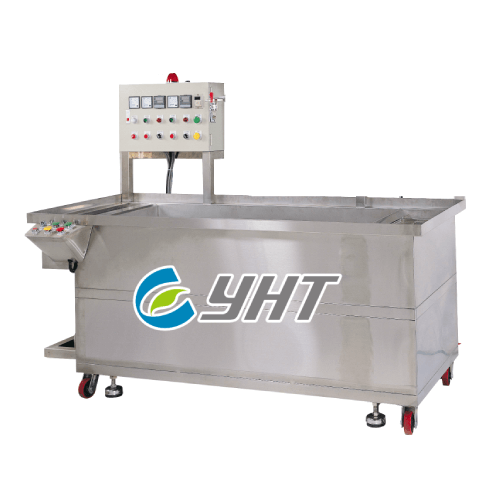
Machine de trempage semi-automatique hydrographique 1M YHT-221
CATÉGORIES : Machines de transfert hydrographique / d'eau
YHT-221 est une machine de trempage standard de 1 mètre sans bras de production qui permet de plonger manuellement les différentes formes de pièces et de répondre aux exigences de petit volume. Différents types de tailles et de types sont tous disponibles pour la demande.
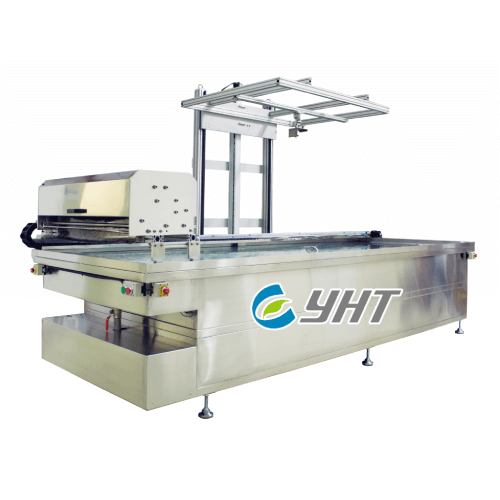
Hydro Dipping Machine- Semi-Automatic- YHT-223A2XF
CATÉGORIES : Machines de transfert hydrographique / d'eau
Réservoir de trempage + couche de film automatique + système de pulvérisation automatique Réservoir de trempage de 3 mètres de long. Une combinaison puissante de tous les processus importants nécessaires pour le traitement WTP. Depuis le tout début de la pose et la pulvérisation de l'activateur qui suit jusqu'à l'étape finale de trempage, effectuez le processus WTP principal avec un seul bouton. YHT-223A2XF Cette machine comprend un réservoir de trempage, une couche de film automatique et un système de pulvérisation automatique. La combinaison de ces 3 composants rend non seulement WTP encore plus simple, mais plus important - une qualité stable pour le produit final. Ce système peut mémoriser plusieurs ensembles de processus différents. YHT-223A2XF est parfait pour les gros produits et les quantités moyennes de production/jour
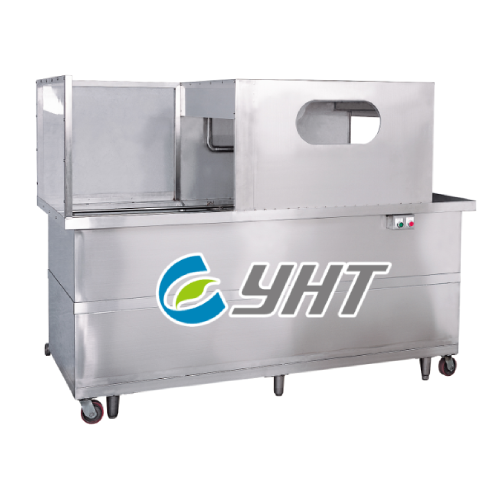
Lavage à l'eau de type semi-automatique 2M - YHT-230
CATÉGORIES : Machines de transfert hydrographique / d'eau
Une station de lavage une par une aide à éliminer les résidus de films et d'activateur par lavage à l'eau. Un seul lot de lavage automatique avec circulation d'eau répond parfaitement aux capacités de diverses machines de trempage.
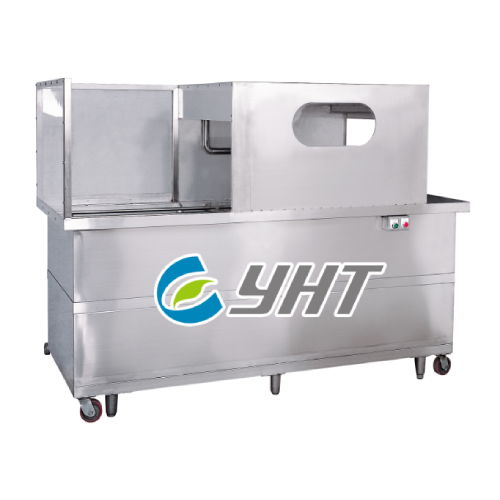
Lavage à l'eau Type semi-automatique 3M - YHT-231
CATÉGORIES : Machines de transfert hydrographique / d'eau
Une station de lavage une par une aide à éliminer les résidus de films et d'activateur par lavage à l'eau. Un seul lot de lavage automatique avec circulation d'eau répond parfaitement aux capacités de diverses machines de trempage.
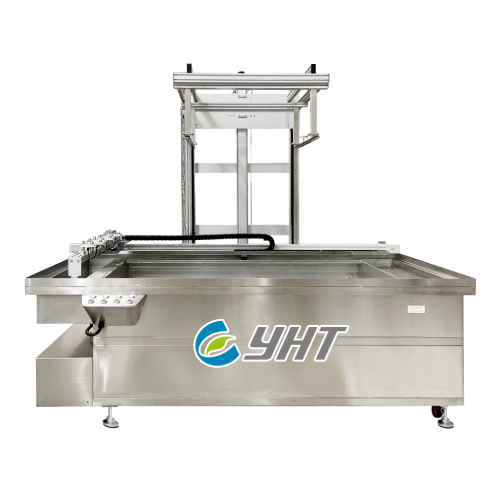
Water Transfer Printing Dipping Machine- Semi-Automatic- YHT-222AX
CATÉGORIES : Machines de transfert hydrographique / d'eau
Trempage manuel ou vertical par bras de production avec cuve de trempage hydraulique à minutage et température contrôlée. La haute durabilité de la structure du réservoir de immersion avec le bras de production à chargement lourd et la circulation de l'eau par le système à double filtre sont le meilleur outil de travail pour votre entreprise de impression par transfert deau.
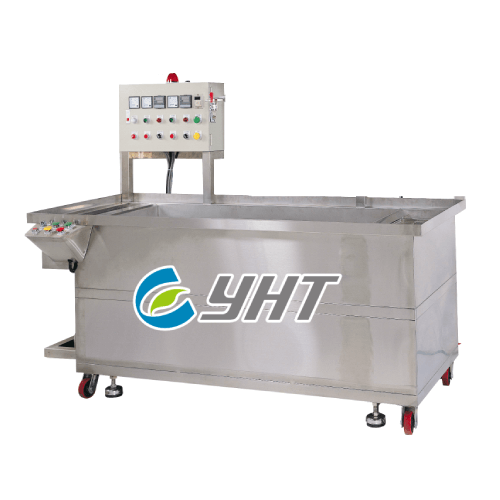
Machine de trempage semi-automatique hydrographique 3M - YHT-223
CATÉGORIES : Machines de transfert hydrographique / d'eau
YHT-223 est une machine de trempage standard de 3 mètres sans bras de production qui permet de plonger manuellement les différentes formes de pièces et de répondre à l'exigence de volume supplémentaire. Différents types de tailles et de types sont tous disponibles pour la demande.
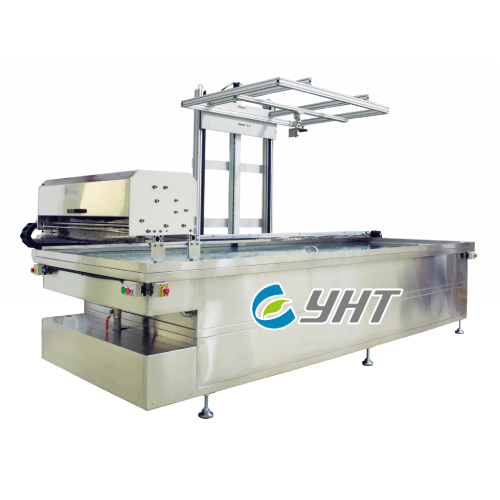
Machine de trempage semi-automatique hydrographique 2M équipée d'une couche de film automatique + système de pulvérisation automatique et bras de production A2 - YHT-222A2XF
CATÉGORIES : Machines de transfert hydrographique / d'eau
Cuve d'immersion + Couche de film automatique + Système de pulvérisation automatique Une combinaison puissante de tous les processus importants nécessaires pour le traitement WTP. Depuis le tout début de la pose, et la pulvérisation d'activateur suivante jusqu'à la dernière étape de trempage, le processus WTP principal a été effectué avec un seul bouton. YHT-222A2XF rend non seulement WTP encore plus simple, mais plus important - la stabilité. ce système peut mémoriser plusieurs ensembles de processus différents
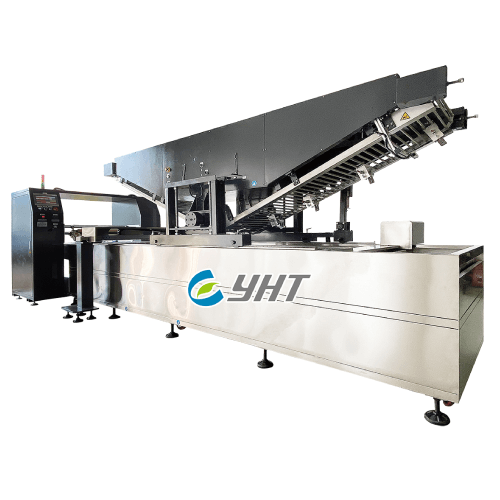
Machine de trempage hydrographique automatique à débit continu avec Tri-con - JK-350TT
CATÉGORIES : Machines de transfert hydrographique / d'eau
Machine de trempage automatique La machine de trempage à débit continu est un excellent système pour fabriquer une quantité quotidienne élevée de 1600 appareils / 8 heures. Grâce à sa conception parfaite du système de transmission triangulaire réglable, cet appareil est capable de fonctionner avec différentes formes de décoration dans différents réglages d'angle.
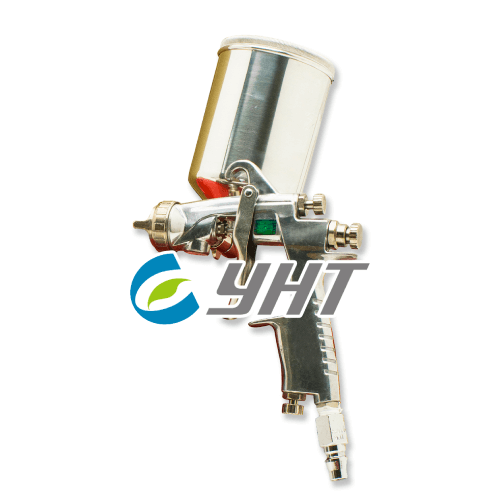
Pistolet de pulvérisation manuel YHT
CATÉGORIES : Machines de transfert hydrographique / d'eau
Pistolet de pulvérisation à haute efficacité, atomise complètement l'activateur lors de la pulvérisation. Suggérer qu'il est utilisé pour la pulvérisation de couches de base, de couches transparentes et d'activateur. Une pulvérisation et une atomisation cohérentes vous fourniront un excellent résultat. Coopérer avec la cabine de pulvérisation : pour la machine de trempage de la couche de base et de la couche de finition
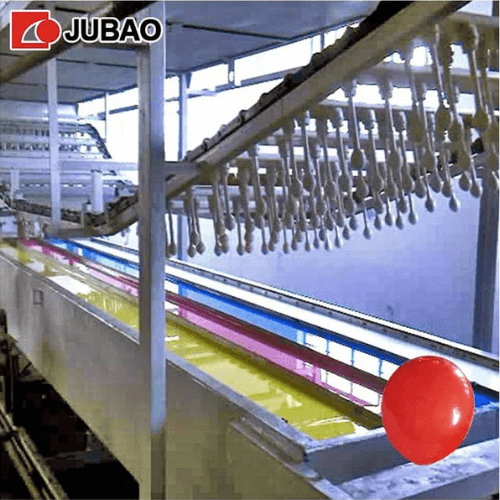
Latex Balloon Dipping Machine-JB-QQ
CATÉGORIES : Machines de Trempage du Caoutchouc
The main craftwork flow is: -Milling -Vulcanization -Stripping Off -Acid Wash -Brush Wash -Hot Water Wash -Dipping Coagulant -Dipping Latex -Drying -Beading -Drying -Add Slurry This machine system realized communication controlled by humanity-machine interface. They raise the digitized level of the system having it steady. Industry level modularization design, simple humanity-machine dialog and main speed and every section temperature can be shown in the screen. Each oven’s temperature can be controlled automatically by the temperature controller. Balloon dipping machine consists of main frame,acid tank,washing tank,stripping device,acid tank,water tank,cogulant tank,oven,latex tank, beading, rail,converying system,ladder, storage tank,vulcanization tank,mixing tank etc. The electric control system include the Programmable Logic Control(PLC), touch screen, converter etc. electronic control units and wires. Except the touch screen and sensors, the other electric parts were installed inside the control box. The control box is easy to maintance. The PLC and its software is the heart of the control system. It is mainly for help the balloon dipping machine to finish its machine action, parameter control and trouble inspection etc. It can control and manage the manufacturing, quality, user operation interface in real time.

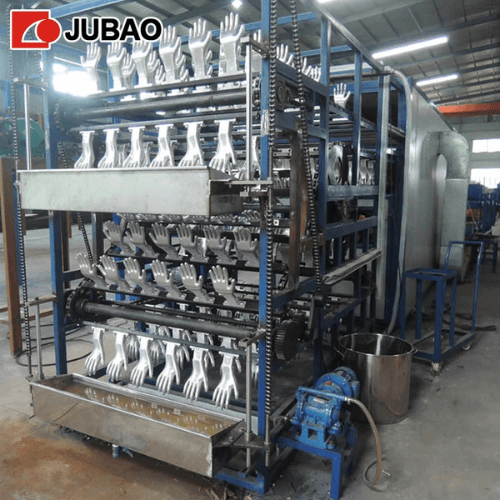
Nitrile And Latex Glove Dipping And Coating Machine-JB-SUB
CATÉGORIES : Machines de Trempage du Caoutchouc
1.The machine use continues moving chain which can produce high capacity and low cost glove. 2.Keep dipping level in balance and adjust dipping length automatically. 3.The molds arrange in tight that save lots of oven space 4.Hot air cycle system to make temperature in oven is even 5.The machine has collect system that can reuse the redundant latex 6.Install a whole row molds that can change the mold by row easily which will not affect the production capacity.
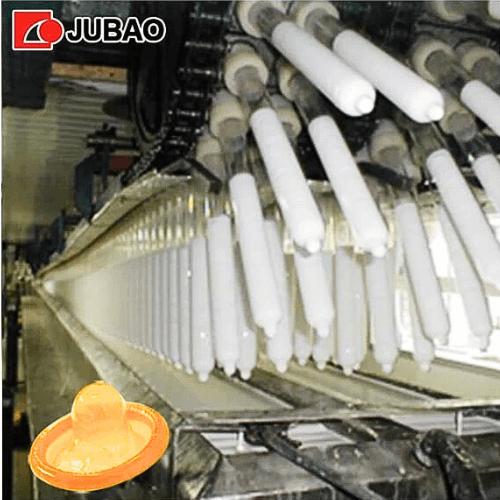
JB-CD Latex Condom Dipping Machine
CATÉGORIES : Machines de Trempage du Caoutchouc
Condom manufacturing machine process Collecting the raw materials Rubber latex is obtained from the milky fluid produced by various tropical plants. Latex is actually an emulsion or dispersion of tiny rubber particles in water, and ingredients added to the latex must be able to attach to the rubber particles during compounding. Compounding Next, chemical additives are mixed to form a paste. This paste is then blended with the liquid latex in a process called compounding. Storage The latex and chemical compound is then unloaded into drums for storage, where it remains for approximately seven days. During this period, vulcanization chemically strengthens the bonds of the rubber. The storage time also allows any air, which might have been trapped in the mixture during compounding, to escape. Dipping The compound is then added to the dipping or condom-forming machine. The dipping machine is a long, hooded machine approximately 100 feet (30.5 m) in length. Thick tempered glass rods move along a closed belt between two circular gears. The belt drags the rods, which are called mandrels, through a series of dips into the latex compound. The mandrels rotate to spread the latex evenly. Several coats are required to build the condom to its required thickness. Between each dip, the latex is hot air dried. After the final dipping and drying, the condoms automatically roll off the mandrels. A machine shapes and trims the ring of latex at the base of each condom. Tumbling Next, the condoms are put in a tumbling machine, where they are coated with talc or another similar powder to prevent the rubber from sticking to itself. Testing After a curing period of several days, the condoms are sampled by batch and tested for leaks and strength. The first such test is the inflation test, in which the condom is filled with air until it bursts. Condoms are required to stretch beyond 1.5 cubic feet, about the size of a watermelon, before bursting. This test is considered most important because the elasticity of the condom keeps it from tearing during inter-course. In the water-leakage test, the condom is filled with 10 ounces (300 ml) of water and inspected for pin-sized holes by rolling it along blotter paper. Condoms are also tested electronically. This involves mounting each condom on a charged stainless steel mandrel. The mandrel is passed over by a soft, conductive brush. If pin holes are present, a circuit will be established with the mandrel, and the machine will automatically reject the condom. Packaging Condoms that have successfully passed these tests are rolled by a machine. Rolling the condom makes it easier to package and use. Lubricant and spermicide may be applied by a metering pump just before the top wrap is added in the foiling process.