English - EN
 繁體 - ZH-TW
 简体 - ZH-CN
 Español - ES
 日本語 - JA
 العربية - AR
 Русский - RU
 Français - FR

Facing Labor Shortages and Regulatory Changes: How JANDI’S JIT-SS Turns Resin into Carton-Packed T-Shirt Bags
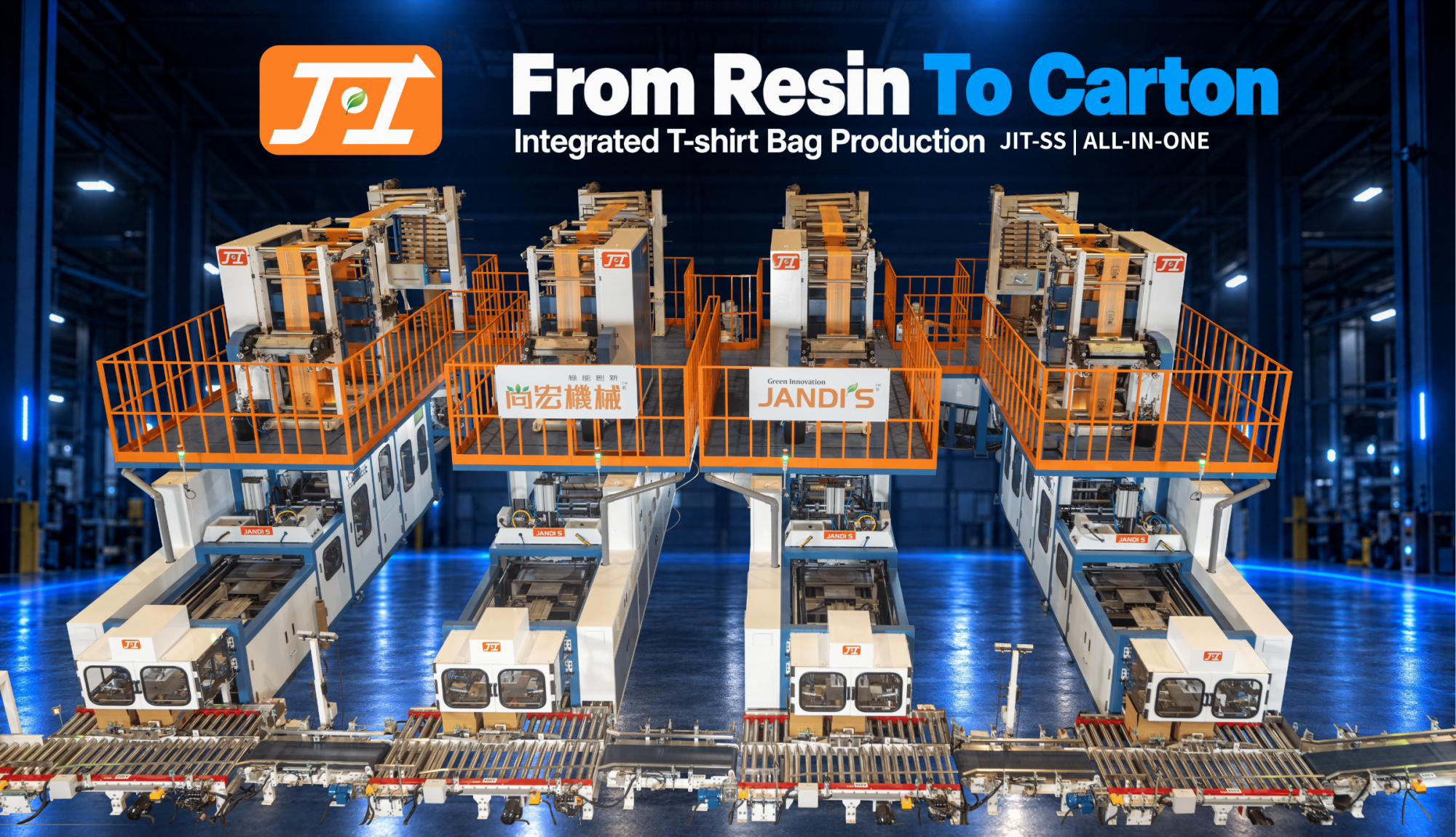
Labor shortages and new rules have bag makers rethinking their lines
Finding workers is hard across manufacturing worldwide, and bag plants feel it too. When blown film, printing, bag making and packing are done on separate machines, every stage needs its own staff. Between stages, rolls have to be moved, work-in-process stored, die-cut scrap collected, and finished bags counted and boxed. These handoffs add waiting time and show up in the cost of every carton.
JIT-SS links blown film, printing, bag making and die-cut recycling in one line, and can be paired with an automatic carton packing system. In a configuration of four JIT-SS lines with an automatic carton packing system, two to three operators can run the whole setup under specified production conditions, reducing the space and labor needed for moving, storing, counting and manual boxing between stages.
Beyond labor, restrictions on plastic products are changing the market. The EU’s Packaging and Packaging Waste Regulation (PPWR) has applied since August 12, 2026, and will phase in requirements for recyclable design, packaging reduction and recycled content. Mexico City has restricted single-use plastic bags since 2020, and other Mexican states and cities have introduced rules of their own. These changes can affect bag material, thickness and design. JIT-SS can process HDPE, LDPE/LLDPE and PBAT/PLA, though material changes and process settings still need to be adjusted to the material and product specifications. Whether the finished product meets local regulations depends on its formulation, intended use and certification.
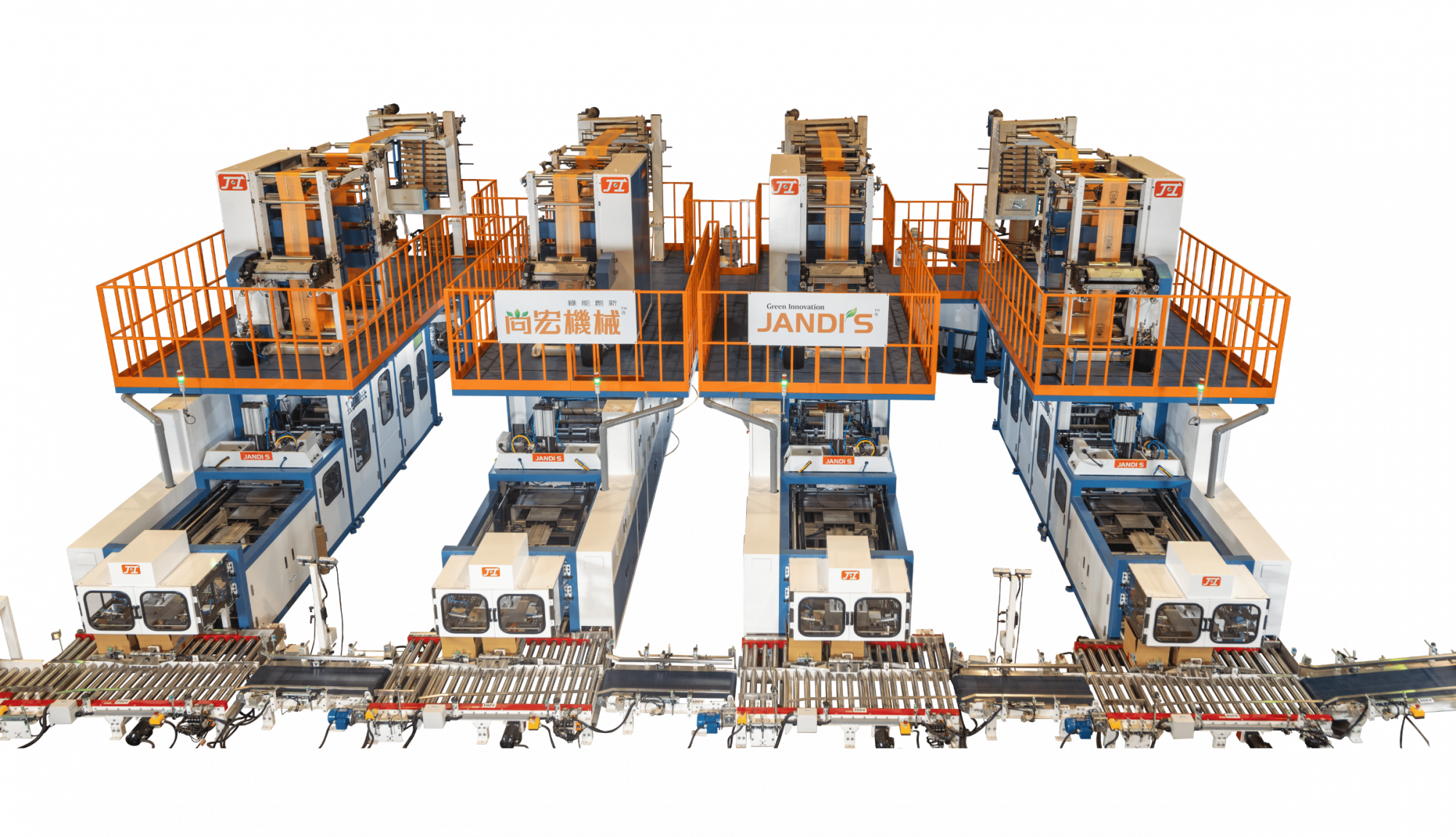
JIT-SS configuration and output
With four JIT-SS lines sharing one automatic carton packing system, the setup makes about 25,000 T-shirt bags per hour, from resin to packed cartons, with a maximum monthly output of 120 tons for the full configuration.
Die-cut scrap typically accounts for 12–18% of the material used for a T-shirt bag. JIT-SS sends die-cut scrap straight back to the extruder during production, with a reuse rate of up to about 15%. This reduces the need to collect, store and process scrap off-line, and improves material utilization.
Configurations vary with bag format, material and output, and buyers are welcome to bring their own specifications to JANDI’S.
Looking at JIT-SS from packing and die-cut scrap
Whether finished bags can be counted and packed automatically determines how many people the packing area needs. JANDI’S offers two packaging solutions for JIT, plastic bags or cartons, so bags no longer have to be collected and counted by hand. It is also worth asking JANDI’S what adjustments are needed when the bag size or carton size changes.
Die-cut scrap deserves attention as well. Die-cut scrap goes straight back to the extruder and is mixed with new material before being blown into film again. Based on JANDI’S experience, thin film scraps melt earlier than resin pellets, and bags are sealed while the film is still warm, which helps maintain bag and seal strength. With HDPE, LDPE/LLDPE or biodegradable resins, die-cut scrap can be reused directly in production as long as the material and formulation are suitable for reuse. The higher the material price, the more the savings from scrap reuse are worth factoring into cost calculations.
Meet JANDI’S at PLASTIMAGEN Mexico 2026
JANDI’S will be at PLASTIMAGEN Mexico 2026, November 10–13, at Centro Banamex in Mexico City, Booth 3223. Bring bag samples and dimensions, material types and print colors to talk through your requirements with the JANDI’S team. If you can’t make it, send your product specifications and output requirements through an online inquiry, and JANDI’S will recommend a suitable configuration.
Exhibition: PLASTIMAGEN Mexico 2026
Date: November 10–13, 2026
Venue: Centro Banamex, Mexico City
Booth: 3223


PARTENAIRE COOPéRATIF