


 English - EN
  繁體 - ZH-TW
  简体 - ZH-CN
  Español - ES
  日本語 - JA
  العربية - AR
  Русский - RU
  Français - FR
Same Recipe, Different Film: Here's Why

Why process variation changes the result — even when the formulation stays the same
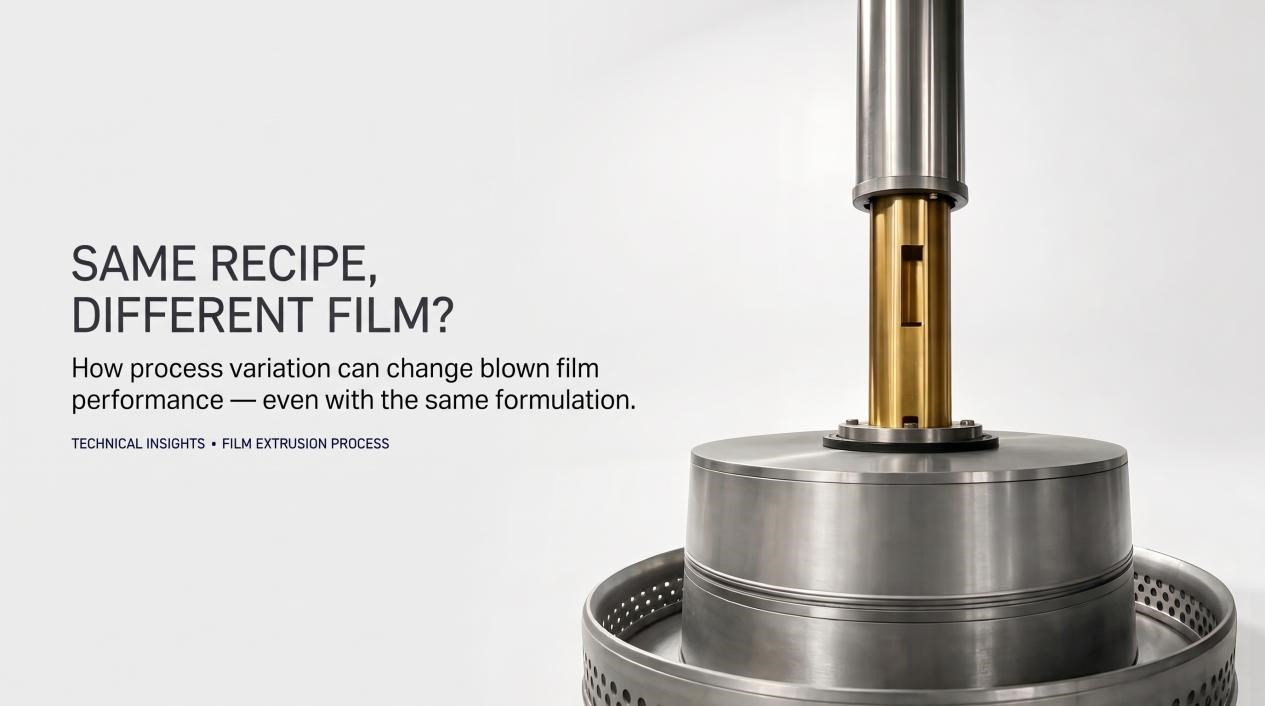
Last week, a customer ran two rolls of film on the same line.
Same formula, same machine, same operator.
One roll came out perfectly fine — the other was full of gels and fish eyes.
They spent three days troubleshooting: swapped resin batches, adjusted the formulation, pulled the screw, checked every temperature zone.
Nothing worked.
Finally our engineer went in, took apart the cooling air ring, and found it — one-third of the air outlets were blocked.
Cleaned the air ring, restarted the line, and everything went back to normal.
Same recipe. Completely different film.
Why?
The answer usually isn't in the formula.
It's tempting to blame the material first.
But more often than not, the recipe isn't the real problem.
The difference comes from how that recipe is processed.
1. The Recipe Is Only One Part of the Equation
A film recipe defines what goes into the process.
It does not define exactly what happens to the material afterward.
The same PE formulation can behave differently depending on:
- Melt temperature and temperature stability
- Screw speed and residence time
- Output stability
- Die pressure and melt distribution
- Cooling efficiency
- BUR and frost-line position
- Haul-off speed
- Winding tension
- Thickness control
Small changes in these conditions can affect film thickness, appearance, mechanical properties, and ultimately the usable output.
That is why two lines can produce film from the "same recipe" without producing the same result.
We commissioned an 1800mm three-layer co-extrusion line where film haze climbed from 8% to 11%. The customer initially suspected a raw material batch issue — it took a full week to trace the root cause: melt temperature had drifted from 190°C to 196°C, a 6-degree rise at the rear extruder.
On another occasion, with the same 50µm target gauge, one line held thickness tolerance at ±3% while another ran at ±8%. The line had originally been designed for 300 m/min, but to keep the film within spec we had to drop the line speed to just one-third of that.
With the same 50µm target, a well-tuned line holds thickness variation within ±3%, while an average line runs at ±8%. Down the line at the bag-making stage, that difference translates to a 20% gap in seal strength.
2. Same Material ≠ Same Process
Imagine two machines running the same LDPE/LLDPE formulation.
Both are targeting 50 μm film.
On paper, everything looks identical.
But one machine may have more stable melt pressure, better cooling, more consistent thickness control, and tighter winding tension.
The other may experience small fluctuations throughout the process.
Neither difference may be obvious when looking only at the formulation.
But they can become obvious in the finished roll.
One roll may have better thickness consistency and cleaner edges.
The other may require more trimming, show more variation, or become harder to use downstream.
3. Where Does the Difference Actually Come From?
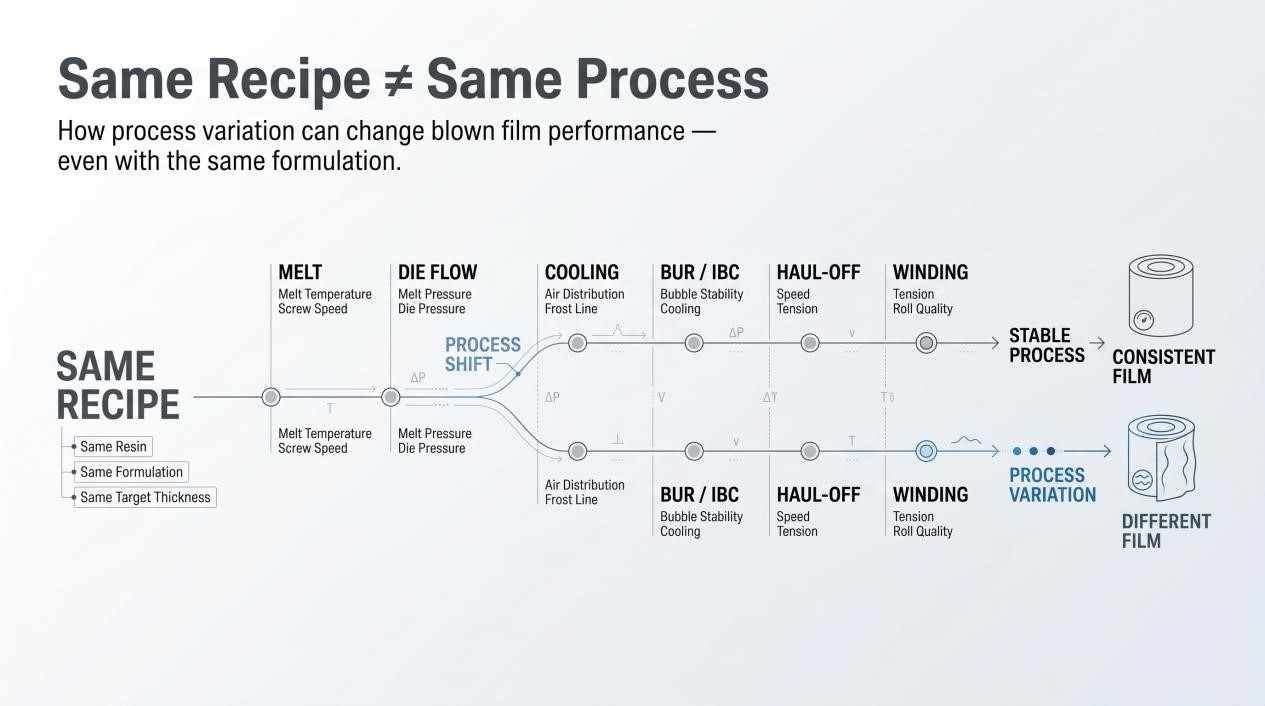
A useful way to look at blown-film production is:
Recipe → Process Conditions → Film Structure → Finished Roll
The recipe establishes the material foundation.
The process determines how that material is transformed.
And the winding stage determines how much of that quality is preserved in the final roll.
This is why troubleshooting should not stop at: "Are we using the correct resin?"
A better question is: "Are we processing the same resin under the same conditions?"
Those are two very different questions.
4. The Hidden Cost Is Often Outside the Recipe
When film quality fluctuates, the first instinct is often to change the recipe.
Add more LLDPE.
Adjust the blend ratio.
Increase or decrease additives.
Switch to a different PPA.
Sometimes this is necessary.
But changing the formula drives up production costs.If the real issue is unstable output, uneven cooling, thickness variation, or inconsistent winding tension, a new formulation may only move the problem somewhere else.
The better approach is to separate the variables.
- Material.
- Machine.
- Process.
- Measurement.
- Winding.
Control them one by one.
5. The Practical Takeaway
A stable film process is not simply about finding the right recipe. It is about making the recipe repeatable.
If the same formulation produces different results from day to day — or from one machine to another — the first question should not always be: "What should we change in the recipe?"
Sometimes the better question is: "What changed in the process?"
Because in blown-film production, consistency is not created by the recipe alone.
It is created by the interaction between material, machine, process control, and winding.
Same recipe.
Different process.
Different film.
That is where the investigation should begin.







PARTENAIRE COOPéRATIF